I only had one morning within Bardia National Park to find whatever I could. My local guide (Sitaram Chaudhary) for the morning was great, and over the next few days we became good friends. After Bardia, we drove a couple of hours to Suklaphanta for a two night stay, allowing a full day within Suklaphanta National Park.
Wednesday 4th March
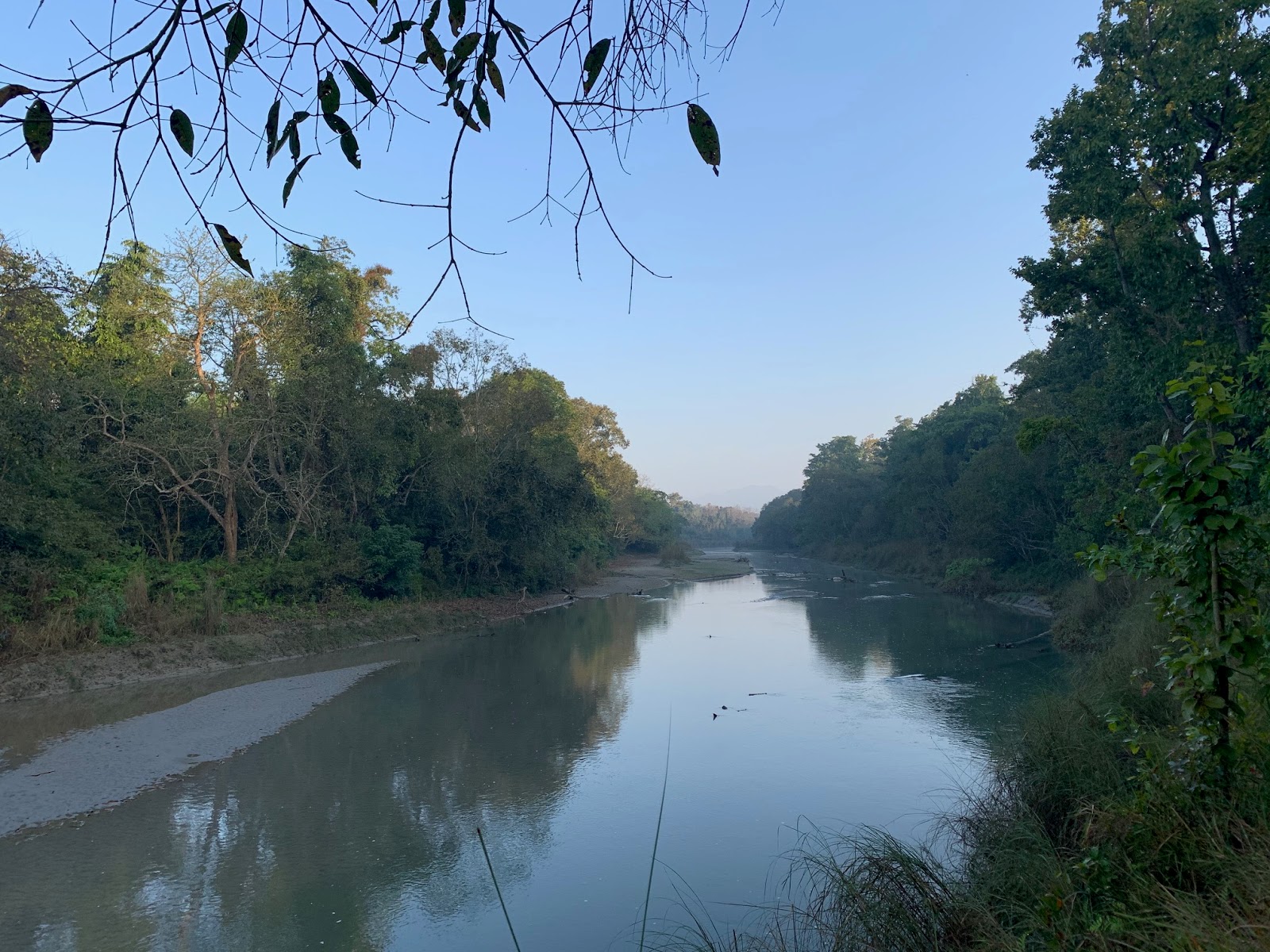
I didn't get much sleep last night, but I was up and ready for a mornings safari drive. To get to the entrance from the Babai Resort it was only a two minutes drive. Passing the formalities of signing in (much more straightforward than in India), we were soon driving the many tracks that criss-cross their way around the park. The understorey was more sparse than it was at Chitwan, and so hopes were high of another tiger sighting, and at one point we came close. After jumping out the vehicle and walking through the jungle for an hour, we saw many incredibly fresh tracks and scent markings. At the river though we managed to get within maybe 20 metres of a One-horned Rhinoceros taking a bath, and just downriver was a delightful party of Smooth-coated Otters - a top highlight.
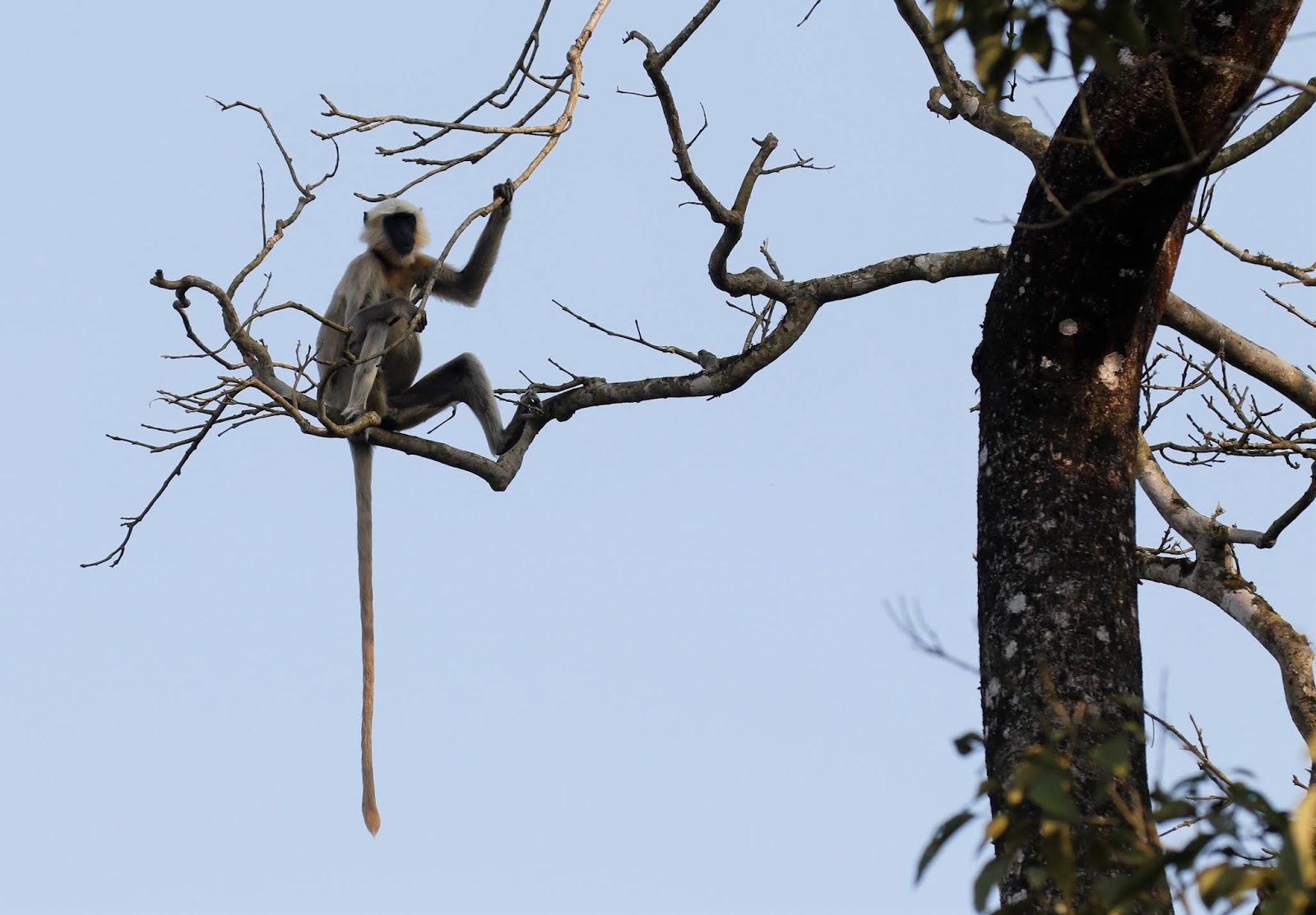
We continued the drive and found ourselves on the edge of the jungle, and once again hopped out of the vehicle to scan from a nearby ridge. As we approached, the monkeys started to bellow out their alarm calls, possibly indicating the presence of a nearby predator. Despite running to the location, we fear we had just missed a sighting of a tiger as we could see all the deer and monkeys focused on an area that frustratingly we couldn't see. Service resumed to normal and therefore we checked an area that is supposedly good for Indian Rock Python. Being a snake fan, I was delighted to see three pythons tucked away in the grasses below us.
Time was pushing on and all too soon there was only time for one last trek out of the jeep. Once again no tigers about, but a Blue-bearded Bee-eater and a small bird flock containing Small Minivets, Greenish Warblers and Oriental White-eyes was some form of compensation.
Once at Babai Resort, I was given a hefty lunch and having felt like I'd only just arrived, it was time to leave (this being the theme of my tour of southern Nepal). Sitaram was thankfully joining me for my time at Suklaphanta National Park. It was only a two hour journey (it felt like seconds after the previous journeys I had undertaken) and by the time we reached the camp, there was still plenty of light to explore the relatively confined grounds. Being adjacent to Suklaphanta, bird life was good with some Indian Grey Hornbills, a Grey-headed Canary Flycatcher and many parakeets forming the highlights.
Highlights are as follows:
Black Stork - 1
Woolly-necked Stork - 7
Crested Serpent Eagle - 1
Shikra - 2
Alexandrine Parakeet - 2
Jungle Owlet - 3
Indian Grey Hornbill - 2
Blue-bearded Bee-eater - 1
Chestnut-headed Bee-eater - 5
Lineated Barbet - 1
Large Cuckooshrike - 2
Small Minivet - 4
Whistler's Warbler - 1
Oriental White-eye - 5
Verditer Flycatcher - 1
Grey-headed Canary Flycatcher - 1
White-rumped Shama - 1
Thick-billed Flowerpecker - 1
White-browed Wagtail - 5
Citrine Wagtail - 5
Grey Wagtail - 1
Olive-backed Pipit - 50
Red Avadavat - 3
Rhesus Macaque
Terai Grey Langur
Smooth-coated Otter - 4
One-horned Rhinoceros - 1
Indian Rock Python - 3


Thursday 5th March
Today, I only had one objective, and that was to see a Bengal Florican. Despite Suklaphanta being an exceptional park for many other rare species, having not seen a florican at Koshi was starting to get to me. We left the camp early, and in the vehicle was myself, Sitarama, the son of the camp's owner, a little lad, and of course the driver. Together we made a formidable team, and not just from a birding prospective, but more on that story later. As we made our way through the pristine jungle, we came across some good birds with a pair of Great Slaty Woodpeckers being the best. It took nearly 90 minutes to reach the recently cut grasslands. Among these grasslands were three viewing towers, and they helpfully had roofs as there was persistent rain all morning. This certainly didn't help our quest of finding a florican, and after a couple of hours and much scanning, there was no sign. There were however many Black Francolins around (somehow a new bird for me) and a couple of Bluethroats scuttling around below the towers.
Interest was soon aimed towards the Swamp Deer that started running out of a marshy area. Once they had stopped, they were all staring into one area, and yet again it was highly likely we were in the presence of a tiger. Despite much scanning we just couldn't make anything out in the long grass, but what an exciting experience nonetheless.
Soon the rain started to ease and eventually stopping, allowing many birds to finally appear. A pair of Swamp Francolins emerged, as did a few White-tailed Stonechats. We had completed a circuit of the towers and were now considering moving on, but we thought we'd give it one last go. Reaching the top of the tower, a Changeable Hawk-eagle flew in very close, and as I was captivated by this, the others started shouting at me as not more than 200 metres away a Bengal Florican was flying straight towards us. It landed for a short time allowing brilliant views before flying off again. We descended the tower and its very steep steps and jumped into the vehicle. Although obscured, the florican showed well from the vehicle before flying off and this time, out of sight...…a brilliant result!! With this finally in the bag, I could enjoy the rest of the afternoon. Another close encounter of a Changeable Hawk-eagle that plummeted down onto a helpless Black Francolin was a superb sight (the Francolin somehow escaped), as was a brief view of an Indian Spotted Civet that crossed the track in front of us. Another river stop produced some River Lapwings and a few more species of deer.
We were now on our way back to the entrance, though this involved a different route back through the park. It was noticeably more damp than the other tracks, not helped by the continuous rain from earlier today. The first section of mud we just about cruised through, but the same couldn't be said for the next section. With steep rutted tracks, we soon became stuck - so stuck we were trying to get out for a couple of hours. Eventually after many tactics, and many muddy clothes later, we won the battle.
A final scout around the camp produced a superb Ultramarine Flycatcher (a new bird for Sitaram).
It had been a brilliant day in Suklaphanta, but once again it was time to move on. The next morning I caught a flight to Kathmandu, and then half-hour later a flight to Pokhara, where I was whisked up to Tiger Mountain Resort. This will be the last and final blog post for my time in Nepal.
Highlights are as follows:
BLACK FRANCOLIN - 5
Swamp Francolin - 2
Ferruginous Duck - 3
Black-necked Stork - 1
Oriental Darter - 1
Long-legged Buzzard - 1
Changeable Hawk-eagle - 1
BENGAL FLORICAN - 1
Indian Thick-knee - 2
Bronze-winged Jacana - 5
Wood Sandpiper - 2
Himalayan Swiftlet - 10
Hoopoe - 2
Stork-billed Kingfisher - 1
STREAK-THROATED WOODPECKER - 1
Great Slaty Woopecker - 2
Long-tailed Shrike - 10
Greater Racket-tailed Drongo - 2
Oriental Skylark - 2
INDIAN GRASSBIRD - 1
Striated Babbler - 5
Ultramarine Flycatcher - 1
Red-spotted Bluethroat - 3
White-tailed Stonechat - 3
Pied Bushchat - 6
Citrine Wagtail - 3
Scaly-breasted Munia - 10
Golden Jackal - 2
Indian Grey Mongoose - 1
Swamp Deer - 300
Water Buffalo - 10
Indian Spotted Civet - 1


Time was pushing on and all too soon there was only time for one last trek out of the jeep. Once again no tigers about, but a Blue-bearded Bee-eater and a small bird flock containing Small Minivets, Greenish Warblers and Oriental White-eyes was some form of compensation.
Once at Babai Resort, I was given a hefty lunch and having felt like I'd only just arrived, it was time to leave (this being the theme of my tour of southern Nepal). Sitaram was thankfully joining me for my time at Suklaphanta National Park. It was only a two hour journey (it felt like seconds after the previous journeys I had undertaken) and by the time we reached the camp, there was still plenty of light to explore the relatively confined grounds. Being adjacent to Suklaphanta, bird life was good with some Indian Grey Hornbills, a Grey-headed Canary Flycatcher and many parakeets forming the highlights.
Highlights are as follows:
Black Stork - 1
Woolly-necked Stork - 7
Crested Serpent Eagle - 1
Shikra - 2
Alexandrine Parakeet - 2
Jungle Owlet - 3
Indian Grey Hornbill - 2
Blue-bearded Bee-eater - 1
Chestnut-headed Bee-eater - 5
Lineated Barbet - 1
Large Cuckooshrike - 2
Small Minivet - 4
Whistler's Warbler - 1
Oriental White-eye - 5
Verditer Flycatcher - 1
Grey-headed Canary Flycatcher - 1
White-rumped Shama - 1
Thick-billed Flowerpecker - 1
White-browed Wagtail - 5
Citrine Wagtail - 5
Grey Wagtail - 1
Olive-backed Pipit - 50
Red Avadavat - 3
Rhesus Macaque
Terai Grey Langur
Smooth-coated Otter - 4
One-horned Rhinoceros - 1
Indian Rock Python - 3
 |
| One-horned Rhinoceros |
 |
| Crested Serpent Eagle |
 |
| Mugger Crocodile |


 |
| Bardia National Park |
 |
| Babai Resort |
Thursday 5th March
Today, I only had one objective, and that was to see a Bengal Florican. Despite Suklaphanta being an exceptional park for many other rare species, having not seen a florican at Koshi was starting to get to me. We left the camp early, and in the vehicle was myself, Sitarama, the son of the camp's owner, a little lad, and of course the driver. Together we made a formidable team, and not just from a birding prospective, but more on that story later. As we made our way through the pristine jungle, we came across some good birds with a pair of Great Slaty Woodpeckers being the best. It took nearly 90 minutes to reach the recently cut grasslands. Among these grasslands were three viewing towers, and they helpfully had roofs as there was persistent rain all morning. This certainly didn't help our quest of finding a florican, and after a couple of hours and much scanning, there was no sign. There were however many Black Francolins around (somehow a new bird for me) and a couple of Bluethroats scuttling around below the towers.
Interest was soon aimed towards the Swamp Deer that started running out of a marshy area. Once they had stopped, they were all staring into one area, and yet again it was highly likely we were in the presence of a tiger. Despite much scanning we just couldn't make anything out in the long grass, but what an exciting experience nonetheless.
Soon the rain started to ease and eventually stopping, allowing many birds to finally appear. A pair of Swamp Francolins emerged, as did a few White-tailed Stonechats. We had completed a circuit of the towers and were now considering moving on, but we thought we'd give it one last go. Reaching the top of the tower, a Changeable Hawk-eagle flew in very close, and as I was captivated by this, the others started shouting at me as not more than 200 metres away a Bengal Florican was flying straight towards us. It landed for a short time allowing brilliant views before flying off again. We descended the tower and its very steep steps and jumped into the vehicle. Although obscured, the florican showed well from the vehicle before flying off and this time, out of sight...…a brilliant result!! With this finally in the bag, I could enjoy the rest of the afternoon. Another close encounter of a Changeable Hawk-eagle that plummeted down onto a helpless Black Francolin was a superb sight (the Francolin somehow escaped), as was a brief view of an Indian Spotted Civet that crossed the track in front of us. Another river stop produced some River Lapwings and a few more species of deer.
We were now on our way back to the entrance, though this involved a different route back through the park. It was noticeably more damp than the other tracks, not helped by the continuous rain from earlier today. The first section of mud we just about cruised through, but the same couldn't be said for the next section. With steep rutted tracks, we soon became stuck - so stuck we were trying to get out for a couple of hours. Eventually after many tactics, and many muddy clothes later, we won the battle.
A final scout around the camp produced a superb Ultramarine Flycatcher (a new bird for Sitaram).
It had been a brilliant day in Suklaphanta, but once again it was time to move on. The next morning I caught a flight to Kathmandu, and then half-hour later a flight to Pokhara, where I was whisked up to Tiger Mountain Resort. This will be the last and final blog post for my time in Nepal.
Highlights are as follows:
BLACK FRANCOLIN - 5
Swamp Francolin - 2
Ferruginous Duck - 3
Black-necked Stork - 1
Oriental Darter - 1
Long-legged Buzzard - 1
Changeable Hawk-eagle - 1
BENGAL FLORICAN - 1
Indian Thick-knee - 2
Bronze-winged Jacana - 5
Wood Sandpiper - 2
Himalayan Swiftlet - 10
Hoopoe - 2
Stork-billed Kingfisher - 1
STREAK-THROATED WOODPECKER - 1
Great Slaty Woopecker - 2
Long-tailed Shrike - 10
Greater Racket-tailed Drongo - 2
Oriental Skylark - 2
INDIAN GRASSBIRD - 1
Striated Babbler - 5
Ultramarine Flycatcher - 1
Red-spotted Bluethroat - 3
White-tailed Stonechat - 3
Pied Bushchat - 6
Citrine Wagtail - 3
Scaly-breasted Munia - 10
Golden Jackal - 2
Indian Grey Mongoose - 1
Swamp Deer - 300
Water Buffalo - 10
Indian Spotted Civet - 1

 |
| White-tailed Stonechat |

 |
| Bengal Florican |
 |
| Common Kingfisher |

 |
| Florican success (Sitaram on the left) |

 |
| Suklaphanta National Park |

 |
| Suklaphanta Rest Camp |